
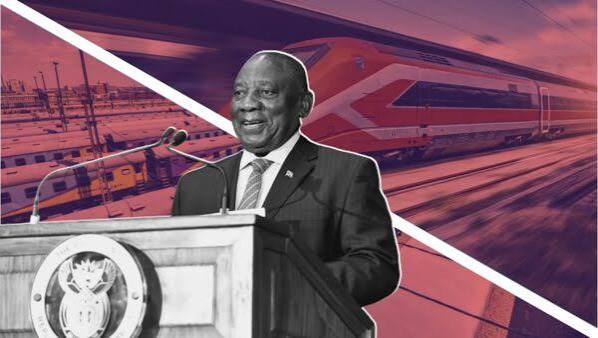
Cyril Ramaphosa’s bullet train did not leave the station: What Has Actually Happened?
In 2019, President Cyril Ramaphosa asked South Africans to imagine a country connected by high-speed trains, with modern rail networks linking major cities and remote communities. A year later, he introduced another ambitious vision: a new smart city in Lanseria that would eventually become home to between 350,000 and 500,000 people.
These were big promises for a country looking to modernise its infrastructure, improve transport and create new economic opportunities.
But six years later, how much of that vision has become reality?
South Africa has made some progress in rebuilding passenger rail and recovering freight operations. However, the country is still dealing with ageing infrastructure, water shortages, electricity distribution problems and significant delays in major development projects.
The Lanseria Smart City remains far from the futuristic urban centre originally described by the President. Meanwhile, South Africa’s passenger rail recovery is real, but it is not the high-speed national rail network Ramaphosa described in 2019.
The contrast between those promises and the country’s current infrastructure position raises an important question: What happened to Ramaphosa‘s vision of a modern, connected South Africa?
Ramaphosa’s 2019 Bullet Train Promise
During his 2019 State of the Nation Address (SONA), Ramaphosa spoke about developing a modern railway system that would connect South Africa’s major economic centres.
He described a future in which high-speed trains would travel between cities, improving connectivity and making long-distance travel more efficient.
His vision included trains passing through Johannesburg on their way to Musina, stopping in Buffalo City while travelling from eThekwini towards Cape Town.
The ambition was to create a country where rail infrastructure played a central role in economic development, passenger transport and regional connectivity.
However, South Africa’s railway system was already facing serious challenges, including infrastructure deterioration, cable theft, vandalism, operational failures and years of underinvestment.
Instead of moving directly towards a nationwide high-speed rail network, government and state-owned transport agencies have had to concentrate on restoring existing infrastructure and getting conventional passenger and freight services back on track.
What Happened to South Africa’s Passenger Rail Network?
The destruction of railway infrastructure became particularly severe during the COVID-19 lockdown period, when vandalism and theft affected numerous railway lines and stations.
Criminals stripped copper cables, damaged signalling equipment and removed railway infrastructure, leaving parts of the Passenger Rail Agency of South Africa (PRASA) network unable to operate.
The damage was not limited to passenger services. It also affected the wider railway system’s ability to support economic activity and transport goods efficiently.
However, it would be inaccurate to suggest that passenger rail has made no progress since those years.
PRASA Has Restored 35 of 40 Passenger Rail Corridors
By the end of 2025, PRASA had commissioned 35 of its 40 priority passenger rail corridors, marking a significant milestone in the recovery programme.
The agency recorded 77 million passenger journeys during the 2024/25 financial year, compared with approximately 15 million in 2022/23.
Government has continued investing in railway infrastructure, including new trains, track rehabilitation, overhead electrical equipment and signalling systems.
In October 2026, the Department of Transport reported further progress on the Gauteng network.
According to the government update, PRASA had completed 865 kilometres of overhead electrical equipment, recovered 51 substations and rehabilitated 187 kilometres of track in the province.
The Pretoria, Mabopane and De Wildt corridor has also received approximately R801.6 million in investment covering overhead electrical equipment, substations, signalling and telecommunications.
These developments show that passenger rail recovery is taking place.
However, restoring a corridor does not necessarily mean that every station, section of track and service frequency has returned to its previous condition. Signalling limitations, security problems and incomplete infrastructure upgrades continue to affect the wider network.
The recovery of conventional passenger rail is important, but it should not be confused with the high-speed rail vision Ramaphosa presented in 2019.
Transnet’s Freight Rail Recovery: A Long Road Back
South Africa’s freight rail network has also experienced years of operational difficulties.
Transnet’s declining performance affected mining companies, exporters, manufacturers and businesses that depend on rail to move goods to ports and distribution centres.
When freight trains could not move sufficient volumes, companies increasingly relied on road transport, adding pressure to the country’s logistics system.
The scale of the decline is reflected in Transnet’s historical performance.
Rail freight volumes fell from approximately 226.3 million tonnes in 2017/18 to 149.5 million tonnes in 2022/23.
There are now signs of improvement.
According to the National Treasury’s Operation Vulindlela Phase II progress report, Transnet moved 160.1 million tonnes in 2024/25. The report projected approximately 168 million tonnes for 2025/26, representing a further recovery.
Transnet also returned to profitability in the financial year ended March 2026, reporting a R4.6 billion profit after tax, according to its results reported by Moneyweb.
However, the recovery remains incomplete. Freight volumes are still below the levels achieved before the railway system’s decline.
The government is also introducing private-sector participation through new train operating companies, with the aim of increasing competition, improving rail capacity and attracting additional investment.
South Africa’s freight railway system is therefore showing signs of recovery, but the country still has substantial work to do before it can match its previous performance.
What Happened to Ramaphosa’s Lanseria Smart City?
The Lanseria Smart City was one of the most ambitious infrastructure projects announced during Ramaphosa’s presidency.
In his 2020 State of the Nation Address, the President said a new smart city was taking shape in Lanseria and would accommodate between 350,000 and 500,000 people within the following decade.
He described a development that would use modern technology, sustainable infrastructure and integrated urban planning.
The project was intended to bring together government institutions, businesses, residential communities and transport infrastructure.
In 2021, Ramaphosa again referred to the development, describing the Lanseria Smart City as the first new city to be built in democratic South Africa.
The project was expected to become an example of modern urban development, with improved public transport, digital connectivity and more efficient municipal services.
But the development has taken considerably longer than the original political announcements suggested.
Lanseria Smart City Still in the Planning and Feasibility Stages
A January 2026 site visit by MyBroadband found little visible construction progress at the proposed smart city site.
The publication reported that the most noticeable development was an incomplete fence near Ashenti Road, while much of the surrounding area remained open land.
By April 2026, solar-powered streetlights had also been installed along parts of Pelindaba Road and Ashenti Road. However, these were installed by City Power as part of an ongoing infrastructure project and were not evidence that the wider smart city had been constructed.
The Gauteng Growth and Development Agency told MyBroadband that the Lanseria Smart City project remained in its pre-designation phase.
This stage involves technical assessments, institutional agreements, economic impact studies and compliance processes before the broader development can advance.
The agency also acknowledged challenges involving informal settlements in the proposed development area, saying the matter was being addressed through intergovernmental processes.
The project’s official status is also reflected in a Gauteng investment document, which identifies Lanseria Smart City as a feasibility-stage mixed-use urban development.
Is There Any Progress on the Lanseria Development?
There are developments associated with the wider Lanseria area, although they should not be confused with completion of the smart city itself.
In February 2026, Gauteng Premier Panyaza Lesufi announced that the Lanseria Smart City initiative had secured R4 billion for Cradle Film Studios, a proposed film production facility expected to create thousands of jobs.
The investment represents an important development associated with the broader area, but it does not mean the residential, commercial and transport infrastructure promised for the smart city has been completed.
Mogale City has also been developing precinct-planning proposals for the Muldersdrift-Lanseria area, including infrastructure, transport connectivity and municipal services.
The wider vision therefore remains alive, but the gap between planning, investment announcements and actual construction remains significant.
Johannesburg’s Infrastructure Crisis Shows the Scale of the Challenge
The contrast between the promised smart city and the condition of existing urban infrastructure is particularly striking in Johannesburg.
The city is one of South Africa’s most important economic centres, but residents and businesses have experienced persistent water interruptions, electricity distribution problems, deteriorating roads and concerns about municipal service delivery.
A Bloomberg report published in August 2024 estimated that Johannesburg required approximately R221 billion to address maintenance backlogs and overdue upgrades across its roads, electricity and water networks.
More recent reporting has continued to highlight the scale of the problem.
In June 2026, the Auditor-General’s findings on Johannesburg’s financial position drew attention to irregular expenditure, unauthorised expenditure and deteriorating infrastructure. The city also acknowledged an infrastructure backlog exceeding R220 billion.
Water supply remains a particularly serious concern.
Reuters reported in August 2026 that Johannesburg was losing an estimated 655 million litres of water per day through burst pipes, equivalent to more than a third of its water supply.
These problems demonstrate why infrastructure investment and maintenance matter as much as ambitious announcements.
Building a new smart city requires reliable water, electricity, roads, transport systems and municipal institutions. Existing cities must also be maintained and upgraded to support residents and businesses.
The challenge is not simply to announce new infrastructure projects. It is to ensure that they are funded, implemented, maintained and able to deliver the services people need.
South Africa’s Infrastructure Promises Versus Reality
Ramaphosa’s 2019 and 2020 announcements presented a vision of a country with modern rail connectivity and new technology-driven cities.
There has been progress in some areas, particularly passenger rail restoration and Transnet’s freight recovery.
However, the broader transformation remains unfinished.
| Original ambition | Position by November 2026 |
|---|---|
| High-speed trains connecting major cities | No nationwide bullet train network has been delivered |
| Restored passenger rail services | PRASA has commissioned 35 of 40 priority corridors, with further work outstanding |
| Modern freight rail network | Freight volumes have improved, but remain below historical levels |
| Lanseria Smart City | Still in pre-designation and feasibility-related processes |
| Modern urban infrastructure | Johannesburg continues to face substantial maintenance and service-delivery challenges |
The difference between these projects is important. Some infrastructure initiatives are progressing, while others remain at planning or early implementation stages.
Final Thoughts: When Will South Africa’s Big Infrastructure Promises Become Reality?
South Africa does not lack ambitious infrastructure plans. The country has identified major transport, logistics, housing and urban development priorities.
The bigger challenge is turning those plans into functioning infrastructure that improves people’s everyday lives.
PRASA’s recovery shows that damaged infrastructure can be rebuilt, while Transnet’s improving freight volumes suggest that operational reform can produce measurable results.
But the Lanseria Smart City illustrates how long major developments can remain in planning and feasibility stages before residents see meaningful construction.
For millions of South Africans, the immediate priorities are reliable public transport, functioning water systems, electricity, safe roads and better municipal services.
The bullet trains and smart cities promised by Ramaphosa remain powerful symbols of what the country hoped to achieve. Whether that vision becomes reality will ultimately depend on delivery, accountability, investment and the ability to maintain the infrastructure already in place.
South Africa’s infrastructure challenge is no longer just about imagining the future. It is about delivering it.


