
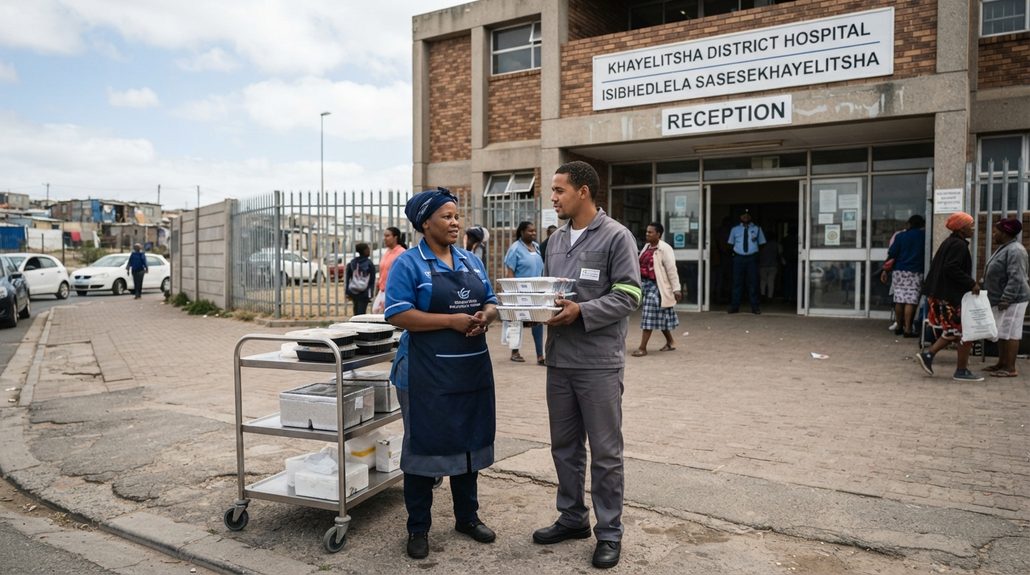
Khayelitsha Hospital Halal Tender Sparks Debate Over Small Businesses and Patient Needs
Last updated: 28 October 2026
A catering tender at Khayelitsha District Hospital has sparked debate over religious accommodation, public procurement and whether certification requirements can make it harder for small local businesses to compete for government contracts.
The controversy centres on a Western Cape Government Health and Wellness tender for a three-year catering service. While the tender was presented as a comprehensive catering contract, its scope specifically described the service as a “Halaal patient catering service” — wording that became a central point of disagreement between local business representatives and the department.
The debate raises a bigger question for South Africa: how can public hospitals meet patients’ dietary and religious needs while ensuring that procurement requirements do not unnecessarily limit opportunities for small and emerging businesses?
What did the Khayelitsha hospital tender require?
The original tender, reference WCGHSC0006/2026, was advertised in January 2026 for a three-year catering service at Khayelitsha District Hospital.
The tender document stated that the contract would cover the provision, operation and management of a halal patient catering service, including menu planning for normal and therapeutic diets and food delivery to patients around the clock.
This detail matters because the document did not simply describe a general retail food certification requirement. It specified a halal catering service for hospital patients, with meals expected to meet the tender’s operational and dietary requirements.
The distinction is important when assessing the controversy. A hospital’s catering arrangements must consider patients’ dietary needs, but a public procurement process must also be clear about why a particular qualification is necessary and how it affects potential bidders.
The original tender document is available through the South African Government eTenders portal.
Why local business representatives objected
The requirement drew criticism from members of the Khayelitsha Business Forum and local catering businesses, who argued that compulsory halal certification could place smaller operators at a disadvantage.
In a report published by City Vision and NovaNews on 18 February 2026, business forum representatives said many local caterers did not hold halal certification and questioned why the requirement had been included in a tender serving a hospital in Khayelitsha.
Their concern was that businesses without the required certification could be excluded before their catering capacity, experience or pricing was fully considered.
For smaller enterprises, the ability to qualify for a public contract can be as important as the ability to deliver the service. A requirement that a business cannot afford or complete within the tender period may become a barrier to entry, even if the business believes it can meet the practical catering requirements.
However, the objections do not, by themselves, establish that the tender was unlawful or that the department intended to exclude Black-owned businesses. Those are questions that require evidence about the procurement process, the justification for the requirement and the applicable rules.
The department’s position: patient needs and inclusive healthcare
The Western Cape Department of Health and Wellness defended its broader responsibility to provide appropriate meals in healthcare facilities.
According to the department’s response quoted by NovaNews, hospital catering must account for patient safety, dignity and diverse dietary, medical and religious requirements. The department also said its procurement processes operate within the relevant supply-chain management and legislative frameworks, while supporting transformation where permitted.
This is an important part of the debate. Hospital catering is not the same as an ordinary restaurant contract. Patients may have dietary requirements linked to medical treatment, religious observance or other personal circumstances.
At the same time, the public interest includes fair access to government opportunities and value for money. The key question is whether the specified certification requirement was proportionate to the service being procured and whether alternative arrangements could meet patient needs without creating unnecessary barriers for capable local suppliers.
Neither patient accommodation nor small-business participation should be dismissed as unimportant. The challenge is finding a procurement approach that takes both seriously.
How much does halal certification cost?
Certification costs are part of the discussion because businesses must consider whether they can afford the process before bidding for work.
The South African National Halaal Authority (SANHA) publishes a fee schedule that includes a once-off application fee of R850 under its Local Certification Scheme. Its published rates also include monthly licensing fees of R350 for cafés and takeaways and R500 for private restaurants. Other categories and assessments have different fees.
These are SANHA’s published rates, not a universal price list for every halal certifier or every type of catering operation. Actual costs depend on the applicable certification scheme, business category and assessment requirements.
Certification can also involve more than paying a fee. Businesses may need to demonstrate that ingredients, preparation methods, handling procedures and other relevant processes meet the certifier’s requirements.
For a small catering business, the practical burden therefore depends on its existing operations, the certification standard required and the time available to comply.
But it is equally important not to overstate the financial argument. Published certification fees alone do not establish how much a particular bidder would have spent, whether the costs were unaffordable or whether they would have materially increased the hospital’s contract price.
The relevant question is whether the tender’s requirements and costs were justified by the service being purchased — and whether the procurement process provided a fair opportunity for capable businesses to compete.
Does halal certification automatically make food more expensive?
The hospital dispute has also fed into wider conversations about halal certification in South African retail, including claims that certification requirements at food outlets and restaurant chains can increase prices for consumers.
That argument needs to be examined separately from the hospital tender.
Certification can involve fees, audits and compliance work. However, the existence of those costs does not prove that a retailer will pass them directly on to customers, or that halal certification is the reason for a particular price increase.
Retail prices can be affected by numerous factors, including ingredient costs, wages, transport, rent, supplier contracts and business pricing decisions.
To establish whether halal certification raises prices, evidence would be needed comparing relevant costs and prices while accounting for other factors. The Khayelitsha hospital tender, on its own, cannot demonstrate a nationwide effect on supermarket prices or restaurant menus.
Consumers and businesses can reasonably ask questions about certification costs and transparency without assuming that every halal-certified product is more expensive because of the certification.
What do South Africa’s religious demographics tell us?
Statistics South Africa’s Census 2022 recorded Muslims as approximately 1.6% of South Africa’s population. The reported share in the Western Cape was higher, at approximately 5.2%.
These figures provide national and provincial context, but they cannot determine the dietary needs of patients at an individual hospital.
A hospital’s patient population may differ from the surrounding community, and population-level religious statistics do not establish how many patients require halal meals at any particular facility.
Equally, the religious composition of a neighbourhood does not, by itself, prove that a halal catering service is unnecessary. That question is better assessed using relevant patient needs, the hospital’s service requirements and the reasoning behind the procurement specification.
The debate should therefore move beyond assumptions about who lives in Khayelitsha and focus on the evidence supporting the hospital’s catering model.
What happened to the tender?
The original tender drew objections from local business representatives. NovaNews reported in February 2026 that the original contract had been cancelled and would be advertised again.
A later tender listing published by Tenders-SA records a subsequent Khayelitsha District Hospital catering award to ITAKANE TRADING 47, dated 15 September 2026, with a reported contract value of R51,740,821.
That later listing indicates that the procurement process progressed to an award. However, the award record alone does not establish whether the halal requirement was changed, how the objections were resolved or what role the controversy played in the eventual outcome.
Those details should be confirmed against the later official tender documents and award records before drawing conclusions about the dispute’s resolution.
The bigger question: balancing religious accommodation and economic access
The Khayelitsha hospital catering controversy highlights a difficult issue in public procurement: requirements designed to meet a legitimate service need can also affect who is able to compete for a contract.
Hospitals must provide appropriate meals and respect patients’ needs. Government departments must also ensure that tender specifications are clearly justified, transparent and consistent with procurement rules, while considering fair participation and value for money.
For small catering businesses, access to public contracts can provide an opportunity to grow, employ staff and build a track record. For patients, suitable meals are part of dignified healthcare. Neither concern should automatically override the other without examining the facts.
The most useful outcome would be a transparent explanation of why the certification requirement was necessary, how it was applied, what changed in the later procurement process and whether capable local businesses had a fair opportunity to participate.
Ultimately, the issue is not simply whether halal certification belongs in public catering. It is whether public institutions can justify their requirements, meet patients’ needs and maintain fair access to government business at the same time.
Frequently asked questions
What was the Khayelitsha hospital halal tender controversy about?
The controversy concerned a Western Cape Government catering tender for Khayelitsha District Hospital that specified a halal patient catering service. Local business representatives argued that the certification requirement could disadvantage smaller caterers who did not hold the required certification.
Why did local businesses object to the requirement?
Business representatives said many local caterers did not have halal certification and raised concerns about access to public contracts. Their objections were arguments about fairness and participation, rather than proof that the procurement requirement was unlawful.
How much does halal certification cost in South Africa?
Costs vary by certifying organisation, business category and certification scheme. SANHA’s published fees include a once-off R850 application fee under its Local Certification Scheme, with separate assessment and licensing fees depending on the business.
Does halal certification make food more expensive?
Certification can create costs for businesses, but that does not automatically mean prices will rise. Establishing a price effect requires evidence about certification expenses, business pricing decisions and other operating costs.
What is the Muslim population of South Africa?
Statistics South Africa’s 2022 Census recorded Muslims as approximately 1.6% of the national population and approximately 5.2% of the Western Cape population. These figures do not establish the dietary requirements of patients at a particular hospital.
Was the Khayelitsha hospital catering tender awarded?
A later tender listing records an award to ITAKANE TRADING 47 dated 15 September 2026, with a reported value of R51,740,821. The listing does not, by itself, confirm whether the halal requirement changed or how the original objections were resolved.
Sources
- Western Cape Government Health and Wellness — original Khayelitsha District Hospital catering tender
- NovaNews / City Vision — Khayelitsha District Hospital Halaal tender controversy, 18 February 2026
- SANHA — certification and published fees
- Tenders-SA — later Khayelitsha District Hospital catering award listing
- Statistics South Africa — Census 2022 religious affiliation data.
