
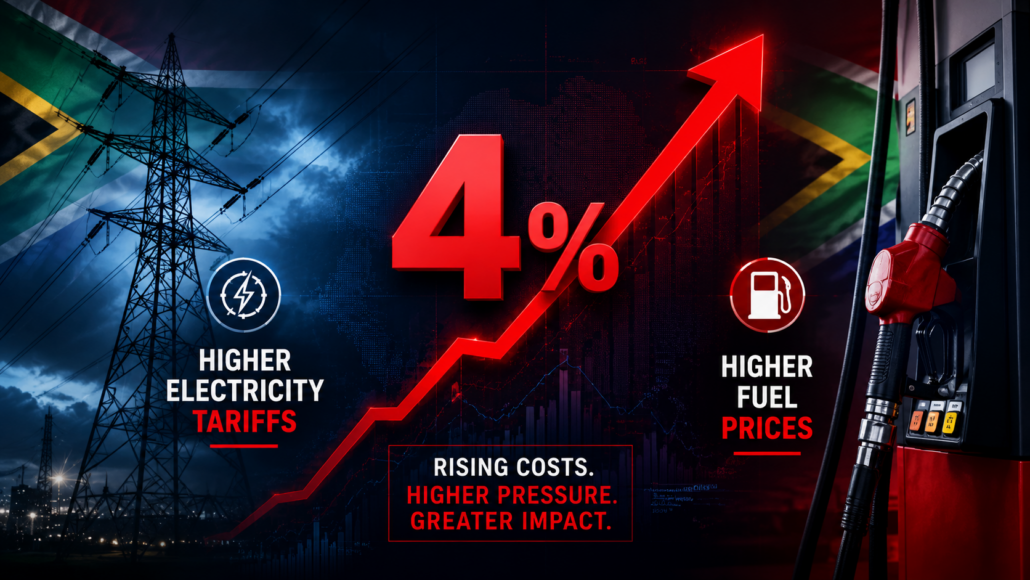
South Africa Inflation Rate Jumps to 4% in April 2026 – Highest Since August 2024
South Africa Inflation Rate Jumps to 4% in April 2026
South Africa’s annual inflation rate accelerated to 4% in April 2026, up from 3.1% in March. Electricity tariffs and petrol prices drove the increase as the SARB’s 3% target moves further away.
Reading Time: 5 minutes
Introduction: Inflation Heats Up in April
South Africa’s annual inflation rate quickened sharply to 4% in April 2026, up from 3.1% in March and slightly above market expectations of 3.9%, according to data from Statistics South Africa.
This marks the steepest reading since August 2024, moving the country further away from the South African Reserve Bank‘s (SARB) preferred 3% inflation target midpoint. The monthly consumer price index (CPI) rose by 1.1% in April, the largest monthly increase since July 2022, after a 0.6% rise in March.
The main drivers? Electricity tariffs and petrol prices.
Key Inflation Data at a Glance
| Metric | April 2026 | March 2026 | Change |
|---|---|---|---|
| Annual Inflation Rate (Headline) | 4.0% | 3.1% | ▲ +0.9% |
| Monthly CPI Change | +1.1% | +0.6% | ▲ +0.5% |
| Core Inflation Rate | 3.6% | 3.2% | ▲ +0.4% |
| Consumer Price Index (CPI) | 106.0 | 104.8 | ▲ +1.2 points |
Source: Statistics South Africa
What Drove the April 2026 Inflation Spike?
Two main categories were responsible for the sharp increase in April: housing and utilities and transportation.
1. Housing and Utilities (5.2% vs 5.1% in March)
This category carries the heaviest weight in the CPI basket at 23%. The acceleration was driven by a recent increase in electricity tariffs, which feed directly into household energy costs.
| Sub-Category | April 2026 | March 2026 |
|---|---|---|
| Housing & Utilities Inflation | 5.2% | 5.1% |
2. Transportation (4.9% vs -1.6% in March)
This was the biggest swing factor. Transportation inflation jumped from a negative 1.6% in March to positive 4.9% in April – a massive 6.5 percentage point turnaround.
The reason: petrol prices were raised in early April, with a lagged pass-through from higher global oil prices linked to the Iran war also contributing.
| Sub-Category | April 2026 | March 2026 |
|---|---|---|
| Transportation Inflation | 4.9% | -1.6% |
Good News: Food Inflation Continues to Ease
Despite the overall inflation spike, there was positive news for South African households.
Food and non-alcoholic beverage inflation eased further to 2.9% in April, down from 3.6% in March. This decline was driven by strong farm output, which has helped keep food prices relatively contained.
| Category | April 2026 | March 2026 |
|---|---|---|
| Food & Non-Alcoholic Beverages | 2.9% | 3.6% |
| Restaurants & Hotels | 5.2% | 5.9% |
Core Inflation Hits Highest Since December 2024
The core inflation rate, which excludes the prices of food, non-alcoholic beverages, fuel, and energy, rose to 3.6% in April – the highest since December 2024 – up from March’s 3.2%.
On a monthly basis, core CPI rose by 0.5% in April, following a 0.8% increase in March.
This is a critical indicator for the SARB because it strips out volatile items and shows underlying inflationary pressures.
CPI Component Breakdown (April 2026)
| Component | Index Value (April) | Inflation Rate |
|---|---|---|
| Core Consumer Prices | 105.60 | 3.6% |
| CPI Food and Non-Alcoholic Beverages | 105.20 | 2.9% |
| CPI Housing and Utilities | 105.80 | 5.2% |
| CPI Transportation | 105.20 | 4.9% |
| CPI Restaurants and Hotels | 105.30 | 5.2% |
| CPI Clothing and Footwear | 101.70 | – |
| CPI Education Services | 110.10 | – |
| CPI Recreation and Culture | 104.30 | – |
Source: Statistics South Africa
CPI Weighting: What Matters Most to South African Inflation
Understanding the weight of each category helps explain why certain price movements matter more than others.
| Category | Weight in CPI Basket |
|---|---|
| Housing & Utilities | 23% |
| Food & Non-Alcoholic Beverages | 19% |
| Transport | 15% |
| Miscellaneous Goods & Services | 15% |
| Alcoholic Beverages & Tobacco | 6% |
| Recreation & Entertainment | 5% |
| Household Contents & Maintenance | 4% |
| Clothing & Footwear | 4% |
| Restaurants & Hotels | 3% |
| Education | 2% |
| Communications | 2% |
Source: Statistics South Africa
Key insight: Housing (23%), Food (19%), and Transport (15%) together account for 57% of the entire CPI basket. When electricity, petrol, or food prices move, inflation moves significantly.
May 2026 Inflation Forecast: What to Expect
According to the latest Trading Economics forecast, the May 2026 inflation rate is projected to rise further to 4.5% .
| Date | Actual | Previous | Consensus | Forecast |
|---|---|---|---|---|
| April 2026 (released May 20) | 4.0% | 3.1% | 3.9% | 4.0% |
| May 2026 (released June 17) | – | 4.0% | – | 4.5% |
The forecasted increase to 4.5% would mark the highest inflation reading since mid-2024 and push the SARB’s 3% target even further out of reach.
Why May inflation could be higher:
- Lagged effects of the April petrol price hike
- Continued pressure from electricity tariffs
- Potential second-round effects from transport costs feeding into other goods
Historical Context: How High Has Inflation Been?
| Period | Inflation Rate |
|---|---|
| All-time high (1968) | 20.7% |
| Recent low (June 2025) | ~3.0% |
| April 2026 | 4.0% |
| SARB target midpoint | 3.0% |
South Africa’s inflation rate has ranged from as low as 0.2% to as high as 20.7% since records began in 1968. The current 4% reading remains within the SARB’s 3-6% target range, but it is moving in the wrong direction from the bank’s preferred 3% midpoint.
What This Means for SARB Interest Rates
The SARB has always been clear: it wants inflation at 3% – the midpoint of its 3-6% target range. April’s 4% reading, combined with the forecast of 4.5% for May, puts pressure on the Monetary Policy Committee (MPC) to consider tighter monetary policy.
| Inflation Trend | SARB Likely Response |
|---|---|
| Below 3% | Rate cuts possible |
| At 3% (target) | Neutral |
| 3-4.5% | Watchful waiting |
| Above 4.5% | Rate hikes likely |
With core inflation also rising to 3.6%, the SARB may become more hawkish in its upcoming meetings.
Related Economic Indicators (March 2026)
| Indicator | March 2026 | Previous |
|---|---|---|
| Producer Price Index (PPI) MoM | 1.1% | 0.0% |
| Producer Price Index (PPI) YoY | 2.3% | 1.8% |
| Producer Prices (index) | 104.50 | 103.40 |
PPI measures inflation at the wholesale level and often precedes consumer inflation. The March PPI increase suggests continued upstream price pressure.
Frequently Asked Questions
What is South Africa’s inflation rate for April 2026?
South Africa’s annual inflation rate was 4.0% in April 2026, up from 3.1% in March.
Why did inflation increase in April 2026?
The main drivers were higher electricity tariffs (housing and utilities category) and higher petrol prices (transportation category), the latter linked to lagged effects from the Iran war pushing up global oil prices.
What is core inflation in South Africa?
Core inflation excludes the prices of food, non-alcoholic beverages, fuel, and energy. In April 2026, core inflation was 3.6%, the highest since December 2024.
Is food inflation rising or falling?
Food inflation eased further to 2.9% in April 2026, down from 3.6% in March, due to strong farm output.
What is the SARB’s inflation target?
The South African Reserve Bank targets inflation at 3% – the midpoint of its 3-6% range.
When will the May 2026 inflation data be released?
Statistics South Africa will release the May 2026 inflation data on 17 June 2026. The forecast is 4.5%.
Final Word
South Africa’s inflation rate jumped to 4% in April 2026, its highest level since August 2024. Electricity tariffs and petrol prices were the main culprits, while food inflation continued to ease thanks to strong agricultural output.
With May inflation forecast to rise further to 4.5%, the SARB’s 3% target is moving further away. This could have implications for interest rates, especially if core inflation continues its upward trend.
Key takeaways:
- Headline inflation: 4.0% (up from 3.1%)
- Monthly CPI: +1.1% (largest since July 2022)
- Core inflation: 3.6% (highest since December 2024)
- Main drivers: Electricity tariffs + petrol prices
- May 2026 forecast: 4.5%
Disclaimer: This article is for informational purposes only and does not constitute financial advice. Inflation data is sourced from Statistics South Africa. Always consult a licensed financial advisor before making investment decisi
