
South Africa Unemployment Q1 2026: Real Rate Hits 43.7%
South Africa Unemployment Q1 2026: Real Rate Hits 43.7%
Youth Capital’s response to QLFS Q1:2026: South Africa’s labour market is not stalling. It is being defunded.
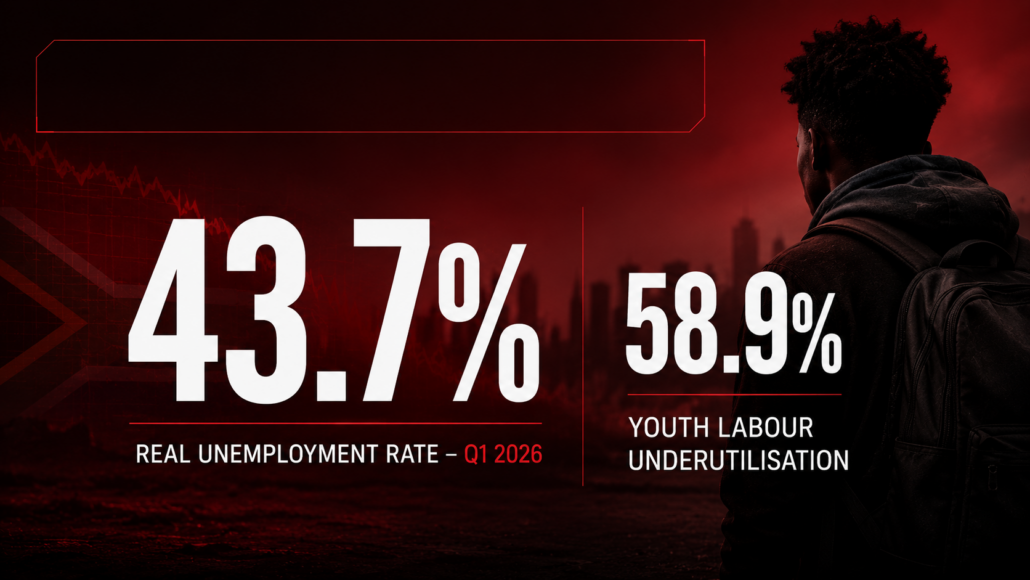
Real unemployment hits 43.7%. Youth labour underutilisation rises to 58.9%. The single largest job loss this quarter is in the sector where public employment programmes operate—ten years of policy drift, captured in one quarter of data.
Today’s release of Statistics South Africa’s Quarterly Labour Force Survey for Q1:2026 should end any remaining pretence that South Africa’s labour market is in a slow recovery. It is not recovering. It is being hollowed out, and the hollowing out is hitting young people first and the hardest.
MORE: https://www.statssa.gov.za/
Official vs Real Unemployment
The official unemployment rate ticked down 0.2 percentage points year-on-year to 32.7%. However, when we look beyond the official unemployment rate and include the discouraged job seekers – people who want work but have stopped actively searching because they no longer believe opportunities exist – the real unemployment rate climbs to 43.7%.
If you include people working fewer hours than they need to survive, then the labour underutilisation rate sits at 46.3%, up 0.6 percentage points from Q1:2025. In practical terms, close to one in every two working-age South Africans is either unemployed, underemployed, or discouraged from seeking work altogether.
Youth Unemployment: Nearly Three in Five Young People Shut Out
For young people aged 15 to 34, the official unemployment rate is 45.8%. The fuller measure, youth labour underutilisation, climbs to 58.9%. This means nearly three out of every five young South Africans are unemployed, underemployed, or discouraged from seeking work.
Of the 3.9 million discouraged work-seekers in South Africa, roughly half are young people under the age of 35.
NEET: Almost One in Two Young People Excluded
The number of youth who are Not in Education, Employment or Training (NEET) should put the country at a standstill. Almost 9.6 million young people aged 15 to 34 are NEET. That is close to one in every two young South Africans.
In effect, nearly one in every two young South Africans aged 15–34 is excluded from employment, education, and training simultaneously. That is the real NEET figure. The 15-to-24 statistic that gets quoted in most coverage (37.6%) understates the scale because it cuts off at 24, just as so many young people are entering the years when they should be in stable, decent work.
Among young women aged 15 to 24, the NEET rate rose 1.7 percentage points year-on-year to 39.2%, while the rate among young men fell.
Ten Years In, The Picture Is Worse, Not Better
Between Q1:2016 and Q1:2026, the number of unemployed South Africans rose from 5.7 million to 8.1 million. The share who have been jobless for a year or longer climbed from 64.9% to 77.4%.
Long-term unemployment has also worsened significantly. In Q1:2026, 77.4% of unemployed adults and 75.5% of unemployed youth had been without work for over a year.
The Gendered and Racial Divide
The exclusion is gendered too. The unemployment rate among Black Africans has remained consistently above the national average for the entire decade, rising from 30.1% in Q1:2016 to 36.4% in Q1:2026.
At 40.5% in Q1:2026, Black women remain the single most vulnerable group in the South African labour market. Two in every five Black African women in the labour force have no job.
The Geography of Exclusion
The geography of exclusion sharpens the point. Unemployment rose in eight of nine provinces in Q1 of 2026 this quarter, with the steepest increases in Mpumalanga, followed by Limpopo.
Youth unemployment now sits at:
- 56.2% in the Eastern Cape
- 53.1% in North West
- 53.1% in the Free State
In the North West, only 37.3% of young people are participating in the labour market. For every ten young people in that province, fewer than four are still trying.

The Job Losses Tell Us Where Government Disinvestment Is Landing
South Africa shed 345,000 jobs in Q1:2026. The single largest loss, 206,000 jobs, was recorded in Community and Social Services. That is the sector in which teaching assistants, community health workers, care workers, and the bulk of public employment programmes operate.
The next largest loss was Construction, at 110,000. The concentration of losses in Community and Social Services — where many public employment programmes operate — raises serious concerns about the impact of recent reductions and uncertainty in public employment funding.
“The latest QLFS data does not paint a picture of a country slowly recovering. It shows a country slowly closing the door on young people. Two million young people have given up the search entirely. Those are not figures waiting to be ‘activated’ by another announcement. These are young people who have been let down for a decade, and who are now watching government defund some of the very programmes that were starting to work for them. The concentration of job losses in Community and Social Services is particularly concerning, given the role public employment programmes play in creating entry points into earning opportunities, work experience, and local economic participation. Young people are not asking government to start from scratch. They are asking government to protect, stabilise and scale interventions that are already demonstrating impact.”
— Buhlebethu Magwaza, Project Lead, Youth Capital
Cuts Are a Political Choice, Not a Fiscal Necessity
These cuts are not a fiscal necessity. They are a political choice. The data shows precisely what that choice produces. In a labour market characterised by long-term exclusion, public employment programmes are increasingly functioning not only as income support mechanisms, but also as pathways into work experience, skills development, and longer-term economic participation.
Youth Capital’s Call to Government (Ahead of the MTBPS)
Youth Capital’s call to government, ahead of the Medium-Term Budget Policy Statement (MTBPS):
- Ring-fence a multi-year PEPs budget, guaranteeing at least 1 million funded public employment opportunities for young people every year, aligned to real local demand.
- Protect and expand proven programmes, including BEEI, CWP, EPWP, and the Social Employment Fund, with measurable, time-bound youth employment targets written into the national budget.
- Move to multi-year funding frameworks for public employment, so that participating young people, implementing partners, and host communities are not held hostage to annual fiscal volatility.
- Recognise public employment as national infrastructure, not a discretionary line item to be cut when the macro environment gets noisy.
The MTBPS: The Next Moment of Choice
The MTBPS is the next moment of choice. Ahead of the MTBPS, the government faces an important policy choice: whether to continue treating public employment as discretionary spending, or recognise it as essential labour market infrastructure in a context of deep and persistent exclusion.
South Africa’s real unemployment hits 43.7% – the highest measure of labour market exclusion. Nearly three in five young people are unemployed, underemployed, or discouraged. Youth Capital calls on government to ring-fence public employment programmes as national infrastructure, not discretionary spending.
#QLFS2026 #UnemploymentSouthAfrica #YouthUnemployment #YouthCapital #PublicEmployment #NEET #MTBPS
FAQ – Youth Capital Response to QLFS Q1:2026
1. What is the real unemployment rate in South Africa for Q1:2026?
The real unemployment rate – which includes discouraged job seekers who want work but have stopped actively searching – is 43.7% in Q1:2026. The official unemployment rate is 32.7%.
2. What is youth labour underutilisation?
Youth labour underutilisation measures young people (aged 15-34) who are unemployed, underemployed (working fewer hours than they need to survive), or discouraged from seeking work. In Q1:2026, this rate stands at 58.9% – meaning nearly three out of every five young South Africans are excluded from meaningful work.
3. What does NEET mean?
NEET stands for Not in Education, Employment or Training. Almost 9.6 million young people aged 15-34 are NEET in South Africa – close to one in every two young South Africans.
4. Which sectors lost the most jobs in Q1:2026?
South Africa shed 345,000 jobs in Q1:2026. The largest losses were:
| Sector | Jobs Lost |
|---|---|
| Community and Social Services | 206,000 |
| Construction | 110,000 |
The Community and Social Services sector is where teaching assistants, community health workers, care workers, and public employment programmes operate.
5. How many discouraged work-seekers are there in South Africa?
There are 3.9 million discouraged work-seekers – people who want work but have stopped actively searching because they believe no opportunities exist. Roughly half are young people under 35.
6. What is the unemployment rate for Black women?
At 40.5% in Q1:2026, Black women remain the single most vulnerable group in the South African labour market. Two in every five Black African women in the labour force have no job.
7. Which provinces have the highest youth unemployment?
| Province | Youth Unemployment Rate |
|---|---|
| Eastern Cape | 56.2% |
| North West | 53.1% |
| Free State | 53.1% |
8. How has unemployment changed over the last decade?
Between Q1:2016 and Q1:2026:
- Unemployed South Africans rose from 5.7 million to 8.1 million
- Long-term unemployment (jobless for 1+ year) climbed from 64.9% to 77.4%
- Black African unemployment rose from 30.1% to 36.4%
9. What is Youth Capital calling for?
Ahead of the Medium-Term Budget Policy Statement (MTBPS) , Youth Capital calls on government to:
| Call | Action |
|---|---|
| Ring-fence a multi-year PEPs budget | Guarantee at least 1 million funded public employment opportunities for young people every year |
| Protect and expand proven programmes | BEEI, CWP, EPWP, and the Social Employment Fund with measurable youth employment targets |
| Move to multi-year funding frameworks | Stop holding young people and communities hostage to annual fiscal volatility |
| Recognise public employment as national infrastructure | Not a discretionary line item to be cut |
10. Why are public employment programmes important?
In a labour market with deep and persistent exclusion, public employment programmes function not only as income support mechanisms, but also as pathways into work experience, skills development, and longer-term economic participation.
11. What is the labour underutilisation rate?
The labour underutilisation rate (which includes unemployed, underemployed, and discouraged workers) is 46.3% in Q1:2026 – up 0.6 percentage points from Q1:2025. Close to one in every two working-age South Africans is either unemployed, underemployed, or discouraged from seeking work.
12. Where can I find the full QLFS report?
The full Quarterly Labour Force Survey (QLFS) Q1:2026 report is available from Statistics South Africa (Stats SA) at www.statssa.gov.za.
13. Who is Buhlebethu Magwaza?
Buhlebethu Magwaza is the Project Lead at Youth Capital, a organisation focused on youth unemployment and labour market advocacy in South Africa.
