
South Africans Are Angry About the New Asylum Rules — Can SA First Forum Help Fight Back?
Last updated: 6 October 2026
South Africa’s asylum system has changed — and the change is becoming another flashpoint in the country’s increasingly heated immigration debate.
Following a Constitutional Court ruling in July, people who entered South Africa unlawfully or failed to comply with certain previous asylum procedures can no longer automatically be prevented from having their asylum claims considered on their merits.
For South Africans already frustrated about illegal immigration, border control and the pressure they believe migration places on the country, the change has landed badly.
The question being asked by critics is straightforward:
Why should someone who entered South Africa illegally now be allowed to enter the asylum process?
And behind that question is a much bigger concern — whether South Africa’s government has the capacity to control immigration while also processing asylum claims properly.
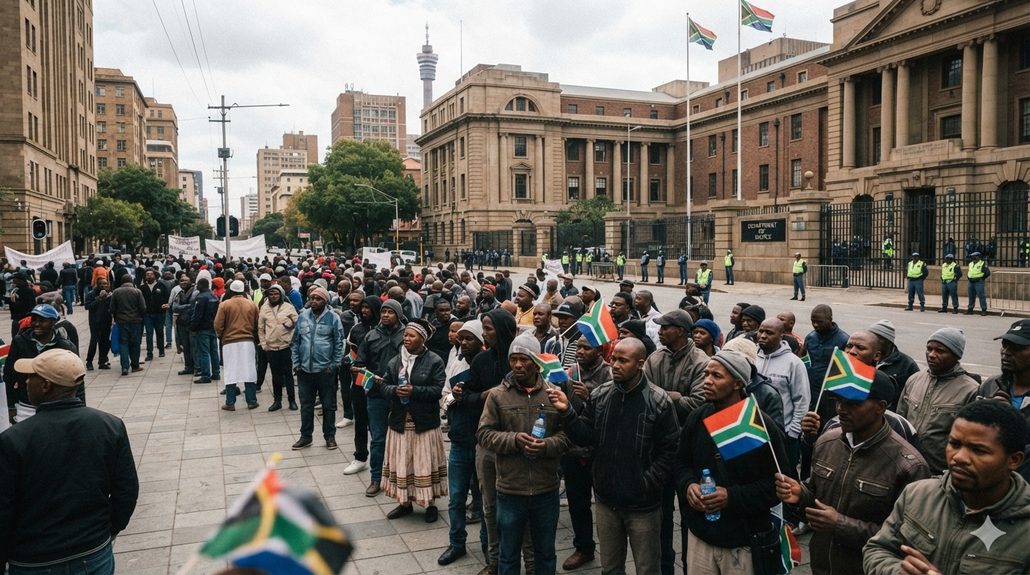
That anger has already spilled onto the streets.
Now, organisations such as SA First Forum are attempting to take the fight beyond protests and into the legal system.
Why South Africans Are Pushing Back
South Africa’s immigration debate has been building for years.
Concerns over undocumented migration have increasingly focused on border control, unemployment, pressure on public services, crime and whether the government is properly enforcing its own immigration laws.
Those concerns have produced increasingly visible protests.
On 30 September, hundreds of people demonstrated in Durban against illegal immigration, calling for stronger border controls and more deportations. The demonstration was led by March and March, which has become one of the most prominent anti-undocumented-immigration movements in the country.
Similar protests have taken place in Johannesburg and elsewhere during 2026.
This is the environment in which the asylum ruling arrived.
For people already demanding tougher immigration enforcement, the idea that someone who entered the country unlawfully can still have access to the asylum process feels like another weakening of immigration control.
But the legal position is more complicated.
What the Constitutional Court Actually Changed
On 7 July 2026, the Constitutional Court confirmed that several provisions of the Refugees Act were unconstitutional and invalid.
The provisions allowed certain immigration-related failures to prevent people from entering the asylum system or from having their claims assessed on their merits.
The Court found that this was inconsistent with the principle of non-refoulement — the protection against returning a person to a country where they could face persecution or serious harm before their claim has been properly determined.
The Court therefore removed those barriers.
This does not mean everyone who applies for asylum automatically becomes a refugee.
It does not mean every application will be approved.
And it does not mean South Africa has abandoned immigration enforcement.
It means the government cannot use certain procedural failures — including unlawful entry — as an automatic reason to prevent an asylum claim from receiving a proper merits-based assessment.
That distinction is crucial.
So Why Are People Angry?
For many critics, the issue isn’t necessarily the legal principle of protecting genuine refugees.
It is what they believe the ruling could mean in practice.
South Africans are already dealing with a Home Affairs system carrying significant backlogs.
Parliament reported in August that Home Affairs had 21,847 pending appeals as of 28 July 2026.
Of those, 13,148 — 60.2% — were overdue.
That raises an obvious concern:
If Home Affairs is already struggling to process existing cases, how quickly will new asylum claims be dealt with?
The fear among critics is that people could spend years inside an unresolved asylum system, making enforcement more difficult and potentially allowing the process itself to become a way of extending someone’s stay.
The government’s challenge is therefore enormous.
It has to comply with the Constitutional Court while ensuring the asylum system does not become permanently overwhelmed.
This Is Bigger Than the Asylum System
The argument has now become part of a much wider fight over South Africa’s immigration policy.
The government has repeatedly said it wants a secure, lawful and well-managed immigration system while respecting the Constitution and South Africa’s international obligations. Home Affairs said after the July ruling that it respected the Constitutional Court and would study the judgment and its implications.
At the same time, enforcement has continued.
That means South Africa is trying to achieve two things simultaneously:
Protect people who genuinely qualify for asylum.
And enforce immigration law against people who do not have a legal right to remain.
The public frustration comes from the perception that the second part has not been working well enough.
Enter SA First Forum
This is where SA First Forum becomes important.
SA First Forum was launched by March and March in August 2026 as a non-profit legal and social-justice organisation.
Its stated purpose is to provide a legal vehicle through which South Africans can challenge government action and pursue cases in the courts. The organisation has specifically positioned itself around issues affecting South African citizens, including immigration enforcement.
Instead of simply protesting outside government buildings, the idea is to build an organisation capable of asking a different question:
Can the government’s immigration decisions be legally challenged?
That could make SA First Forum significant in the next stage of the immigration debate.
How Could SA First Forum Help?
If it operates within the law and pursues cases with a sound legal basis, SA First Forum could potentially help South Africans turn immigration concerns into formal legal challenges.
1. Challenge government decisions
If citizens believe Home Affairs or another government institution is failing to enforce legislation properly, a legal organisation can investigate whether there are grounds for judicial review or other legal action.
That is very different from attempting to enforce immigration laws privately.
2. Take public-interest cases to court
The organisation can potentially identify cases that raise broader questions about immigration policy and ask the courts to determine whether government decisions are lawful.
This is particularly important because South Africans cannot simply overturn a Constitutional Court judgment through protest.
The legal system has to be used to challenge future decisions or legislation.
3. Push for better immigration enforcement
SA First Forum can use litigation and advocacy to put pressure on government departments to explain how they are enforcing immigration laws.
That could include issues involving:
- undocumented immigration;
- border management;
- asylum processing;
- deportation procedures;
- Home Affairs backlogs;
- corruption;
- documentation;
- and the enforcement of existing immigration legislation.
4. Help South Africans understand their rights
Another potentially important role is legal education.
The immigration debate is often filled with claims about what people can and cannot legally do.
A legal organisation can help separate the actual law from social-media claims.
That matters because being frustrated with immigration policy does not give private citizens the right to detain, assault, evict or deport foreign nationals themselves.
Those powers belong to the state and must be exercised according to law.
5. Give citizens another route besides protest
This may ultimately be SA First Forum’s most important role.
Protests can demonstrate public frustration.
Political pressure can influence government.
But litigation can force a specific legal question before a court.
SA First Forum has said it intends to use that route.
Its launch came after months of March and March protests and was explicitly presented as a way of taking the movement’s concerns into the legal system.
Could SA First Forum Reverse the Asylum Ruling?
Not directly.
This is where expectations need to be realistic.
The Constitutional Court’s July judgment is binding.
SA First Forum cannot simply take the judgment to court and ask another organisation to cancel it.
The more realistic route would be to challenge future government implementation, legislation, regulations or administrative decisions where there is a legitimate constitutional or legal basis for doing so.
Parliament could also change legislation, provided the new law complies with the Constitution and survives constitutional scrutiny.
That is the distinction between challenging the judgment itself and challenging what happens after the judgment.
There Is Already a Legal Immigration Fight Taking Shape
The emergence of SA First Forum comes at a time when immigration is increasingly becoming a legal battleground.
The organisation has already indicated that it intends to take government-related immigration matters to court. Its launch was specifically linked to the broader March and March campaign for stronger enforcement of immigration laws.
March and March has also engaged with AfriForum about legal strategies and advocacy, while SA First Forum has described itself as a civic rather than political vehicle.
That could change the character of the debate.
Instead of only asking:
“Why isn’t government doing more?”
South Africans could increasingly ask:
“What exactly is government legally required to do — and what happens if it fails?”
That is a much more consequential question.
But There Is Another Side
Any discussion about the new asylum rules has to acknowledge why the Constitutional Court made its decision.
The Court was concerned that procedural failures could prevent people with potentially legitimate refugee claims from ever having those claims assessed.
A person fleeing persecution may not necessarily arrive through a designated port, possess the correct documentation or report to the authorities within the required timeframe.
The Court therefore held that those failures cannot automatically shut the door on a merits-based asylum assessment.
That protection remains part of South Africa’s constitutional and international obligations.
So the debate cannot simply be reduced to:
South Africans versus asylum seekers.
The actual policy challenge is more difficult:
How does South Africa protect genuine refugees while preventing abuse of the asylum system, controlling its borders and ensuring that people who have no legal right to remain are removed lawfully and efficiently?
South Africa Still Has to Enforce Immigration Law
The Constitutional Court ruling did not eliminate immigration enforcement.
People whose asylum claims are rejected can still be subject to the applicable legal processes, including removal where they have exhausted the relevant avenues.
And the government continues to describe its objective as a lawful and well-managed immigration system.
The problem is implementation.
If Home Affairs cannot process applications and appeals efficiently, the distinction between a genuine refugee, an economic migrant and someone abusing the asylum process becomes harder to manage.
That is precisely why the backlog issue matters so much.
The Question South Africans Are Now Asking
The anger around the asylum changes is unlikely to disappear simply because the Constitutional Court has spoken.
For many South Africans, the argument is now about whether the country is being properly managed.
They want stronger borders.
They want immigration laws enforced.
They want government departments to work faster.
They want undocumented migration addressed.
And they want public resources protected.
At the same time, South Africa remains legally bound to protect people who genuinely qualify for refugee protection.
Those two objectives have to exist together.
SA First Forum could become one of the organisations attempting to force that balance through the courts.
Whether it succeeds will depend not on the size of the protests, but on the strength of the legal cases it brings, the evidence behind them and how South African courts interpret the Constitution and immigration law.
The Bigger Fight Is Only Beginning
The July Constitutional Court judgment settled one legal question: certain procedural barriers cannot be used to prevent asylum seekers from having their claims properly assessed.
It did not settle South Africa’s wider immigration crisis.
That debate is still unfolding.
The protests are continuing.
The government is still enforcing immigration laws.
Home Affairs is still dealing with major backlogs.
And SA First Forum is now attempting to create a legal vehicle through which South Africans can challenge government decisions they believe are failing them.
For South Africans who want the country’s immigration policy changed, that may prove more consequential than another protest.
The next battle could be fought in court.
What changed under the new asylum rules?
| Issue | Position after the July 2026 ruling |
|---|---|
| Illegal entry | Cannot automatically prevent an asylum claim from being assessed |
| Failure to report on time | Cannot automatically block access to a merits-based assessment |
| Asylum application | Does not automatically mean refugee status |
| Genuine refugee claim | Still requires assessment |
| Immigration enforcement | Continues under applicable law |
| Government policy | Must comply with the Constitutional Court judgment |
| Public challenge | Citizens can use lawful political, administrative and judicial channels |
| SA First Forum | A new legal/civic organisation seeking to represent South Africans through litigation |
Frequently Asked Questions
Why are South Africans angry about the new asylum rules?
The backlash is connected to wider concerns about undocumented immigration, border control, public services, unemployment, crime and the capacity of Home Affairs to process immigration matters efficiently. Recent demonstrations have shown significant public frustration over these issues.
Did the Constitutional Court make everyone eligible for asylum?
No. The judgment removed certain procedural barriers to accessing the asylum system. A person’s claim must still be assessed to determine whether they qualify for refugee protection.
Can South Africans reverse the Constitutional Court judgment?
The judgment itself cannot simply be overturned through protests. Future legislation, regulations or government implementation can, however, be challenged through the appropriate constitutional and legal processes.
What is SA First Forum?
SA First Forum is a non-profit legal and social-justice organisation launched by March and March in 2026. It has positioned itself as a legal vehicle for representing South Africans and pursuing government-related matters through the courts.
How can SA First Forum help with immigration concerns?
It could potentially support public-interest litigation, challenge government decisions where there are legal grounds, assist with legal representation and educate citizens about their rights. Its effectiveness will ultimately depend on the cases it brings and the decisions of the courts.
Can SA First Forum deport undocumented immigrants?
No. Private organisations and citizens do not have the legal authority to carry out deportations. Immigration enforcement and deportation are matters for the state and must follow the law.
Can someone who entered South Africa illegally still apply for asylum?
The July Constitutional Court ruling means unlawful entry cannot by itself prevent the person’s asylum claim from receiving a merits-based assessment.
Does the ruling mean South Africa has opened its borders?
No. The ruling concerns access to the asylum process. It does not remove South Africa’s immigration laws or mean that every asylum application will be approved.
