
March and March Supports VaTsonga Machangana Protest Against Tribalism, Affirms Immigration Fight Is Not Anti-Tsonga
The March and March Movement has declared its full support for the VaTsonga Machangana community following a protest against tribalism and discrimination, while reaffirming that its campaign against undocumented immigration is not directed at any South African ethnic group .
VaTsonga Machangana Protest: Demanding Dignity and Recognition
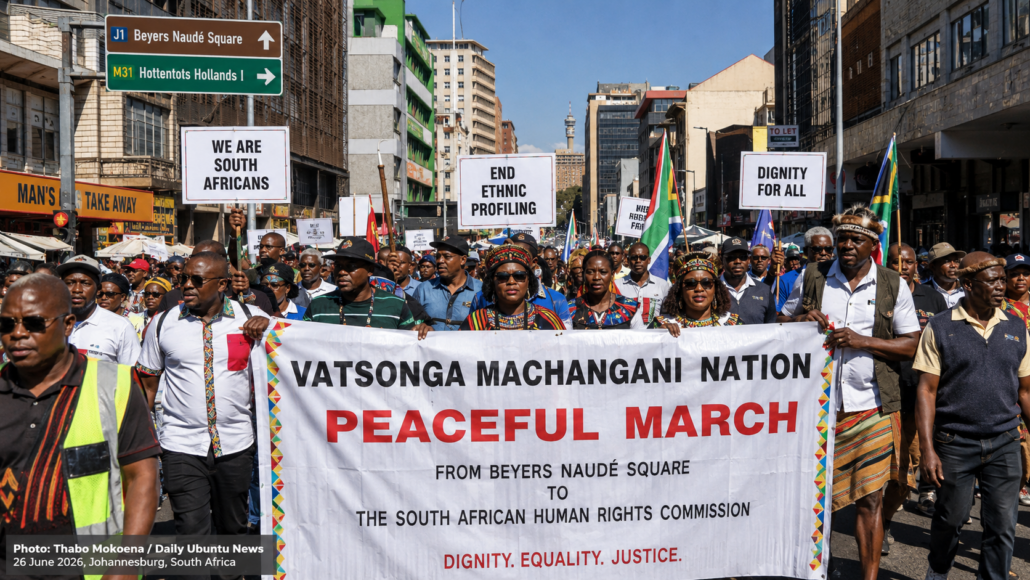
On 26 June 2026, hundreds of members of the VaTsonga Machangana community marched through the streets of Johannesburg to the South African Human Rights Commission (SAHRC) in Braamfontein . The protest was sparked by what the community describes as years of ethnic profiling, discrimination, and harassment directed at Tsonga-speaking South Africans .
The community’s memorandum to the SAHRC expressed deep concern over a growing crisis where VaTsonga Machangana are being subjected to discrimination, harassment, violence, and intimidation due to their language, identity, and cultural expression .
Key Grievances
- Misidentification as Foreigners: Many Tsonga-speaking South Africans are regularly mistaken for foreign nationals because of their language, physical appearance, and cultural ties to neighbouring Mozambique .
- Forced to Prove Citizenship: Community members report being stopped by strangers and forced to produce identity documents to prove their South African citizenship .
- Fear of Speaking Their Language: Some marchers said they are now afraid to speak Xitsonga in public .
- Fatal Consequences: The memorandum referenced the killing of 19-year-old Nhlamulo Sambo in Mossel Bay during a protest in May 2026. Sambo, originally from Limpopo, was stabbed to death because he was Tsonga and mistaken for a foreigner. His family has not yet received justice .
“We are tired of hearing the phrase ‘Mashangani Abahambe’ in our community. I am a South African citizen, but I’m treated as a foreigner in my own country.” — Tinyiko Cossa, from Elandsfontein informal settlement .
“When other tribes hear them speak a language that they don’t understand, they then require them to prove that they are South Africans. We don’t believe that a random South African has the right to ask another to prove their identification.” — Wandile Maluleke, National Co-ordinator, VaTsonga Machangana Association Civic Movement .
Demands to the SAHRC
The VaTsonga Machangana movement called for:
- Public condemnation of the targeting of South African citizens based on language, ethnicity, or cultural identity .
- Recognition of VaTsonga Machangana traditional leaders .
- Harsh sentences for perpetrators of discrimination and violence .
- Public awareness campaigns on citizens’ rights and the country’s cultural diversity .
- Improved border management by the state, rather than civilian-led immigration enforcement .
The SAHRC has been given 15 days to respond to the memorandum .
March and March Responds: “This Is Not a Tribal Fight”
In a statement issued on the same day as the VaTsonga Machangana protest, the March and March Movement strongly rejected claims that its campaign against undocumented immigration is tribalistic or anti-Tsonga .
Key Points from March and March’s Statement
- Full Support for VaTsonga Machangana: The movement declared its full support for the protest against all manifestations of tribalism, discrimination, and prejudice directed at Tsonga-speaking people in South Africa .
- Campaign is Against Undocumented Immigration, Not Ethnic Groups: March and March reiterated that its campaign is directed against undocumented and illegal immigration, not against people because of their ethnicity, language, culture, or nationality .
- Recognition of Legal Foreign Nationals: The movement equally recognises that many foreign nationals are legally present in South Africa, contribute positively to the economy and society, and deserve to be treated with dignity and protected under the law .
- VaTsonga Are an Integral Part of South Africa: The statement emphasised that VaTsonga are an integral and indispensable part of South Africa’s rich national heritage, having made enormous contributions to the country’s liberation struggle, democratic development, economic growth, public service, education, arts, culture, and sport .
March and March’s Position on Tribalism vs. Immigration
“While we unequivocally oppose tribalism, this position does not replace or weaken our unwavering determination to confront the challenge of undocumented and illegal immigration through lawful, constitutional and peaceful means.” — March and March Movement Statement .
The movement maintains that undocumented immigration is fundamentally a matter of:
- Protection of the Rule of Law — Every sovereign nation has the right and responsibility to know who enters its territory and who resides within its borders .
- Protection of Public Services — Proper immigration management assists the government in planning, budgeting, and ensuring that services are delivered effectively to all lawful residents .
- National Security and Crime Prevention — A well-managed immigration system strengthens border security and helps prevent the exploitation of undocumented migration by organised criminal syndicates .
- Protection of Labour Standards — A regulated labour market protects both South African workers and legally employed foreign nationals .
- Effective Governance and National Planning — Reliable population information enables the government to plan infrastructure, schools, hospitals, transport systems, housing, and economic development .
An Invitation to Build Unity
March and March extended an invitation to the VaTsonga Machangana community to join the National Action scheduled for 30 June 2026, stating that South Africans are strongest when they stand together against division, discrimination, and lawlessness while simultaneously defending constitutional values, social justice, and the rule of law .
“There should be no contradiction between rejecting tribalism and supporting lawful immigration management. Both objectives seek to build a united, peaceful and prosperous South Africa.” — March and March Movement .
The 30 June National Action: What You Need to Know
Protest Details
| Detail | Information |
|---|---|
| Date | 30 June 2026 |
| Organiser | March and March Movement |
| Purpose | Nationwide demonstrations against undocumented immigration |
| Status | Proceeding despite eThekwini Municipality refusal |
Dispute with eThekwini Municipality
The March and March Movement has vowed to proceed with its planned 30 June demonstration in eThekwini despite the municipality refusing permission, citing national security concerns .
March and March’s Position:
- The movement claims it complied with all legal requirements under the Regulation of Gatherings Act, including prior notice and consultation with authorities .
- It alleges that the municipality’s refusal was communicated verbally without written reasons or a security threat assessment .
- The movement invoked Section 17 of the Constitution, which protects the right to assemble, demonstrate, and present petitions .
- In the absence of a lawful written prohibition, the movement maintains the gathering remains scheduled to proceed .
“After sitting in our Section 4 meeting, the City of eThekwini has refused us the right to protest on the 30th of June, citing a security threat.” — Jacinta MaNgobese-Zuma, March and March Movement Leader .
Government Response
President Cyril Ramaphosa has placed security forces on high alert ahead of the 30 June protests . While acknowledging that concerns about illegal immigration are genuine, he warned that lawlessness would not be tolerated .
“Our security forces are ready. NATJOINTS is firmly in charge of what could happen… Illegal immigration remains a significant challenge for South Africa, with implications for service delivery and social cohesion.” — President Cyril Ramaphosa .
KwaZulu-Natal Police Commissioner Lieutenant General Nhlanhla Mkhwanazi said police would deal with crime according to the law, stating that “no amount of crime calls for an attack on another person which could lead to their death” .
DA federal leader Geordin Hill-Lewis called on SAPS and the criminal justice system to enforce the law on 30 June, stating:
“No individual or group gets to set deadlines for who may live in South Africa. No one may demand another person’s papers in the street. No one may threaten a family, close a shop, block a road or loot a business.” .
International Response
Several African countries have issued alerts and warnings to their citizens in South Africa ahead of the 30 June deadline, with some countries, including Ghana and Nigeria, reportedly working to evacuate citizens .
The Nigerian government has confirmed that South African authorities have assured the diplomatic community that the 30 June deadline is not a government directive and that no harm should come to foreign nationals after this date .
The Legal Position on Immigration Enforcement
President Ramaphosa’s Address
In a national address on 7 June 2026, President Cyril Ramaphosa made it clear that enforcing immigration laws is the job of the state, not private citizens or community groups .
“The responsibility for enforcing immigration laws rests with the state alone.” — President Cyril Ramaphosa .
Citizens’ Arrests: What the Law Says
March and March leader Jacinta Ngobese-Zuma has cited the Criminal Procedure Act and the Immigration Act as legal grounds for citizens to make arrests . However, legal experts and government officials have disputed this interpretation.
The Criminal Procedure Act allows private citizens to make arrests without a warrant only under specific circumstances:
- The person must be committing or attempting to commit a Schedule 1 offence (serious crimes like murder, rape, kidnapping, robbery, and fraud) .
- Being in South Africa without documentation is NOT on that list .
The Immigration Act does not grant citizens the power to detain undocumented immigrants. The power to stop someone and demand proof of their right to be in the country belongs to police officers and immigration officers alone .
SAHRC Legal Action
The South African Human Rights Commission (SAHRC) has previously taken legal action against groups like Operation Dudula and March and March over their actions, particularly regarding blockades at public healthcare facilities .
“Our Constitution does not allow for vigilante enforcement of immigration laws, nor does it permit anyone to deny medical services to another person based on their nationality.” — SAHRC Statement .
Summary of Key Players
| Entity | Position |
|---|---|
| March and March Movement | Campaigning against undocumented immigration; supports VaTsonga Machangana protest against tribalism; proceeding with 30 June action |
| VaTsonga Machangana Community | Protesting discrimination, ethnic profiling, and harassment; demanding recognition and protection |
| SAHRC | Investigating complaints; previously taken legal action against vigilantism |
| President Cyril Ramaphosa | Security forces on alert; warns against lawlessness; reaffirms state’s role in immigration enforcement |
| eThekwini Municipality | Refused permission for 30 June protest citing national security concerns |
| African Governments | Issuing alerts; some countries evacuating citizens |
Let us refuse attempts to divide South Africans along tribal or ethnic lines. Let us reject hatred wherever it emerges. Let us protect the dignity of every South African. — March and March Movement .
