
Local Government Polls on 4 November – Voter Registration & Key Issues
South Africa Elections 2026: Local Government Polls on 4 November – Voter Registration & Key Issues
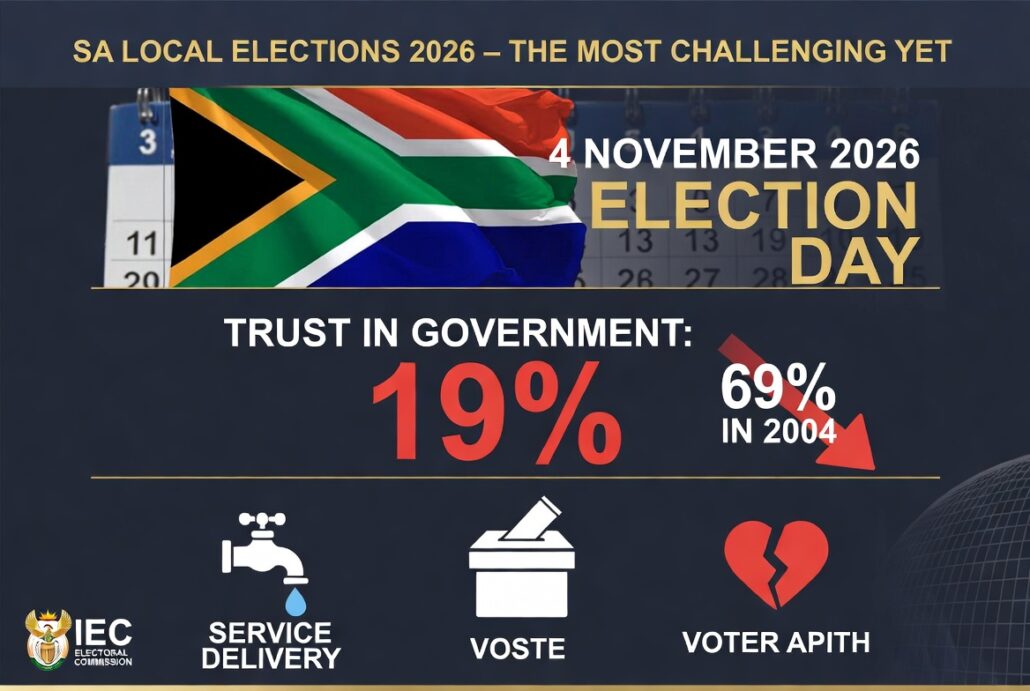
South Africa’s 2026 local government elections are set to be the most challenging in the country’s democratic history, taking place against a backdrop of unprecedented voter disillusionment, crumbling service delivery, and historic lows in trust in political institutions.
Key Election Dates
| Event | Date |
|---|---|
| Voter Registration Weekend | 20 – 21 June 2026 |
| Election Day | Wednesday, 4 November 2026 |
The State of South African Democracy
The Electoral Commission of South Africa (IEC) has described the 2026 local government elections as taking place in the “most challenging pre-electoral climate observed over the last 30 years”.
Trust in key political institutions has collapsed to historic lows:
| Institution | Trust Level (2026) | Change Since 2004 |
|---|---|---|
| National Government | 19% | Down from 69% |
| Parliament | 20% | Down from 65% |
| Local Government | 18% | Down from 55% |
| Political Parties | 11% | Down from 42% (2005) |
| IEC | 32% (total population) | Down from 74% |
IEC Deputy Chief Electoral Officer Masego Sheburi told Parliament that many South Africans feel “betrayed by broken promises and pervasive corruption, leading them to believe voting is meaningless”.
Voter Registration & Turnout Crisis
The 2026 elections are expected to see continued low voter turnout, following a decline from 58% in 2016 to 46% in 2021. According to IEC research:
- If an election were held imminently, only 64% of surveyed citizens said they would vote (down from 76% in 2015)
- Dissatisfaction with democracy has risen from 63% expressing happiness in 2004 to 68% expressing dissatisfaction in 2025/26
- 62% of unregistered voters have no intention of registering to vote
- More than 60% of non-registered young adults (18-34) do not intend to register
Youth Disengagement: A Growing Concern
Young people aged 18 to 35 account for just 28% of the registered voter base. Only 15% of councillors elected in 2021 were under 35.
The South African Local Government Association (SALGA) has urged young South Africans to register and take an active role in shaping their municipalities, warning that young people “cannot afford to be absent from decisions that affect jobs, service delivery, accountability and the future of their communities”.
Research shows 40% of 18-to-34-year-olds do not trust the IEC, presenting a significant challenge for democratic participation.
The Erosion of Democratic Faith
Perhaps most alarmingly, new HSRC research has found that 26% of South Africans now see non-democratic alternatives as acceptable. In Gauteng, the country’s most populous province, only 28% said democracy was preferable to any other system of government.
“Voter turnout remains a constant concern for political parties and the state alike. The lower the number of voters, the more worried we are about the state of our democracy.”
— President Cyril Ramaphosa
The Defining Issue: Service Delivery
Unlike national elections, local government polls are rarely about ideology alone. Voters care about water coming from taps, refuse collected on time, and streetlights actually working.
South Africa’s water crisis, felt acutely in Knysna, Johannesburg, and Durban, has emerged as the defining issue of this campaign cycle. Water is now described as “the new load-shedding”.
A survey found that 47% of South Africans say no political party represents their views, despite more than 500 parties being registered with the IEC. The biggest competitor every party faces in November is not the ANC, DA, EFF, or MK – it is apathy itself.
Recent By-Election Results
In a recent by-election held on 10 June 2026 in the Swartland Municipality (Western Cape), the Patriotic Alliance (PA) won a seat previously held by the Democratic Alliance (DA).
Raymond Ricardo Mains (PA) secured 53.26% of votes in Ward 11, up from 44.93% for the PA in the 2021 Municipal Elections. Voter turnout was 58.15%.
A Crowded Political Arena
More than 500 registered political parties will be vying for 10,439 seats across the country, with over 100,000 prospective candidates.
Political analyst Lucky Mathebula notes that opposition to the ANC has grown increasingly complex: “Julius Malema’s EFF represents a generational break from liberation-era youth politics, while the MK Party adds another layer of significant identity vote-driven fragmentation. Identity-driven parties, such as the Patriotic Alliance and Freedom Front Plus, continue to grow”.
South Africa has now entered an era in which voters prioritise their love for their country or municipality over loyalty to political organisations.
Coalition Politics Are Here to Stay
Since the 2016 local government elections, several major metropolitan municipalities have been governed through coalition arrangements after no single political party secured an outright majority. This trend is expected to continue in key metropolitan municipalities, including Tshwane, Johannesburg, Ekurhuleni, eThekwini and Nelson Mandela Bay.
Analyst Neethling has stated: “Coalitions are here to stay. That’s literally what we’re going to have for the next two decades.”
Ipsos analyst Mari Harris notes: “The upcoming elections may well produce more coalition-led municipalities, and voters seem to be ready for that”.
How to Register & Vote
The IEC will open around 24,000 voting stations during the voter registration weekend on 20 and 21 June 2026.
- Register online: Visit the IEC website
- Register in person: At your local IEC office or voting station during registration weekend
- Required documents: Green ID book, smart ID card, or temporary ID certificate
- Check your registration status: Online via the IEC portal
Link: https://www.elections.org.za/
Key Takeaways
- Election Date: Wednesday, 4 November 2026
- Voter Registration: 20–21 June 2026
- Trust in National Government: 19% (down from 69% in 2004)
- Voter Turnout (2021): 46% (down from 58% in 2016)
- Seats Available: 10,439
- Registered Parties: 500+
- Youth Unregistered (18-34): 60%+ not intending to register
- Key Issue: Service delivery, particularly water and infrastructure
- Coalitions: Expected to continue in major metros
- Democratic Faith: 26% find non-democratic alternatives acceptable
South Africa’s 2026 local government elections take place on 4 November. Voter registration weekend is 20-21 June. With trust in government at an all-time low of 19%, this is the most challenging election cycle in 30 years.
#SAElections2026 #LocalGovernmentElections #IEC #VoteSA #Democracy #ServiceDelivery
–
