
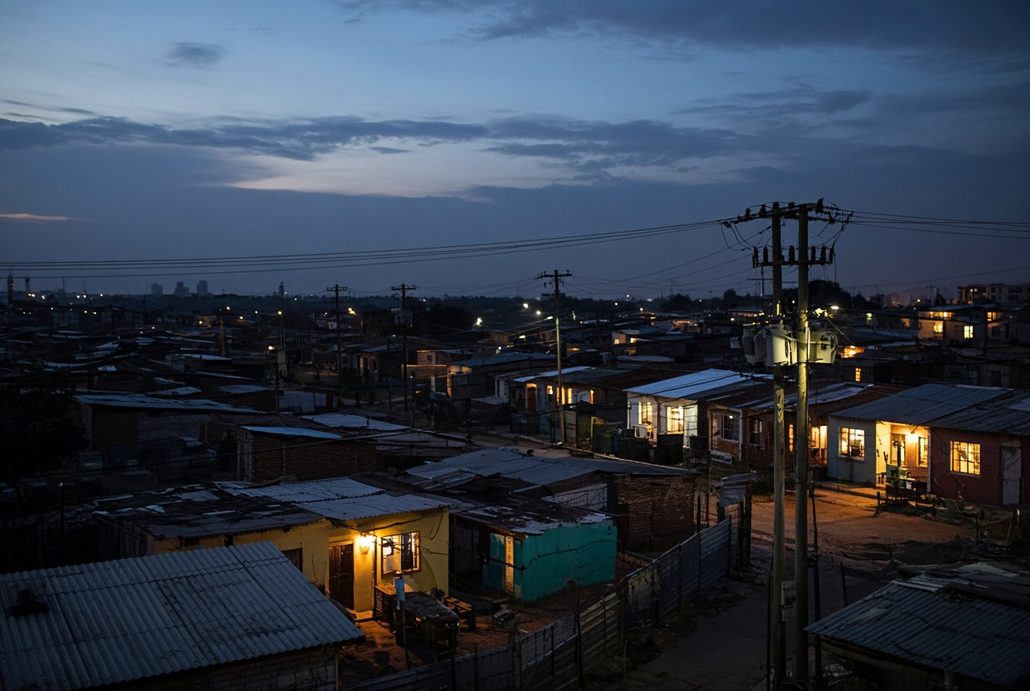
Why Is Soweto Still Losing Electricity When South Africa Has No Load-Shedding?
Soweto’s electricity crisis has changed. South Africa has gone 490 days without national load-shedding, but parts of Soweto are still experiencing load reduction — while Johannesburg electricity tariffs have increased by 8.63%.
Last updated: 22 September 2026
For millions of South Africans, the end of national load-shedding was supposed to mean one thing: more reliable electricity.
But in parts of Soweto, the experience is more complicated.
Residents can still wake up without power, prepare for scheduled interruptions and spend hours waiting for electricity to return — even though Eskom says South Africa has now gone 490 consecutive days without national load-shedding.
That apparent contradiction is at the centre of Soweto’s electricity story in 2026.
The country’s generation problem has improved dramatically.
The local distribution problem has not disappeared.
And households are dealing with another change at the same time: Johannesburg’s electricity tariff increased by an average 8.63% from 1 July 2026.
The numbers behind Soweto’s electricity problem
SOWETO ELECTRICITY — SEPTEMBER 2026
| Figure | What it means |
|---|---|
| 490 days | South Africa without national load-shedding as of 18 September |
| 67.96% | Eskom’s financial-year-to-date Energy Availability Factor |
| 247,617 | Eskom customers still affected by load reduction nationally |
| 8.63% | Johannesburg’s approved average electricity tariff increase |
| 9.01% | City Power’s overall average tariff increase |
| 27% | Johannesburg’s reported electricity distribution losses |
| R3.5 billion | Potential additional revenue if losses fall from 27% to 15% |
| March 2027 | Eskom’s target for eliminating load reduction for its customers |
Eskom reported on 18 September that its generation fleet had achieved a 67.96% Energy Availability Factor for the financial year to date, its highest such level in six years.
It also reported that approximately 3,100MW of generation capacity had returned to the grid, while diesel expenditure had fallen by R4.8 billion year-on-year.
Yet 247,617 Eskom customers remained affected by load reduction, with the remaining affected customers concentrated in Gauteng and KwaZulu-Natal.
That is where Soweto comes in.
So why is Soweto still losing electricity?
The most important distinction is between load-shedding and load reduction.
They are not the same thing.
Load-shedding
Load-shedding is used when the national electricity system does not have enough available generation to meet demand safely.
It operates across different areas according to a national schedule.
Load reduction
Load reduction is much more localised.
It is used in areas where electricity networks are under severe pressure, with Eskom identifying factors including electricity losses, illegal connections, meter tampering and overloaded infrastructure.
The objective is to protect the network from damage while longer-term interventions are carried out.
Soweto is therefore not necessarily experiencing the same electricity problem South Africa was dealing with during the worst years of load-shedding.
The problem has moved closer to the distribution level.
Soweto still has scheduled load-reduction blocks
Published Soweto load-reduction schedules show different parts of the township being placed into rotating blocks.
The schedule includes areas such as Protea Glen, Protea South, Chiawelo, Diepkloof, Orlando, Dube, Mofolo, Meadowlands, Jabavu, Dobsonville, Naledi, Zola and surrounding communities.
The published schedule generally uses the morning and evening peak periods:
05:00–09:00
and
17:00–22:00.
However, these schedules can change, so residents should confirm interruptions through Eskom or the relevant distributor before relying on a particular block or time.
That distinction is important for anyone searching “Soweto power outage today”.
A power interruption could be:
- scheduled load reduction;
- planned maintenance;
- an equipment failure;
- a transformer problem;
- cable damage;
- vandalism or theft;
- or another local network fault.
It isn’t automatically national load-shedding.
South Africa’s electricity generation has actually improved
This is what makes the current Soweto situation so interesting.
Eskom says the national generation system is performing substantially better than it was during the worst period of the electricity crisis.
Between 1 April and 17 September 2026, Eskom’s Energy Availability Factor reached 67.96%.
Weekly EAF was 72.74% between 11 and 17 September.
Eskom also reported a 6.92% improvement in year-to-date unplanned outages, while approximately 6,202MW of generation capacity has been returned to the grid compared with three years ago.
The utility says this improvement has helped South Africa reach 490 consecutive days without load-shedding since 16 May 2025.
That is a major change.
But it doesn’t automatically fix an overloaded distribution network in Soweto.
The electricity problem has moved downstream
Think about the electricity system as a chain:
Power station → transmission network → distribution network → local transformer → household
Improving the power stations doesn’t automatically repair every part of the network at the other end.
That is increasingly important to understanding Soweto.
The national generation fleet can have sufficient capacity while a local feeder or transformer serving a community remains under pressure.
That’s why:
No national load-shedding does not necessarily mean every community has uninterrupted electricity.
This is arguably the most important thing residents need to understand about South Africa’s current electricity transition.
Then there is the tariff increase
While some Soweto communities continue experiencing interruptions, Johannesburg households are also paying more for electricity.
The City of Johannesburg’s approved 2026/27 municipal tariffs came into effect on 1 July 2026.
The approved average increase for electricity is 8.63%.
But there is an important distinction.
City Power’s overall average tariff increase is 9.01%, reflecting the increase in the cost of bulk electricity.
The City says it limited the increase applied to residential customers so that the effective average household increase is 8.63%.
Eskom’s own 2026/27 tariff adjustment shows an 8.76% increase for standard Eskom direct tariffs, while local-authority tariffs are adjusted by 9.01%.
So there isn’t one universal “Soweto electricity price.”
The amount a household actually pays depends on factors including:
- who supplies the property;
- the applicable tariff;
- electricity consumption;
- whether the customer uses prepaid electricity;
- and whether the household qualifies for social support.
What does the 8.63% increase actually mean?
This is where simply reporting the percentage can be misleading.
An 8.63% average increase does not mean every household will receive exactly 8.63% fewer units when buying prepaid electricity.
Electricity tariffs contain different components.
Eskom’s 2026/27 tariff structure includes changes to fixed-cost recovery, including its Generation Capacity Charge and service and administration charges for applicable tariffs. Eskom says corresponding energy rates have been adjusted on some tariffs so that the overall annual increase remains aligned with the approved increase.
City Power also has its own municipal tariff structure.
So the experience of someone buying R100, R200 or R500 prepaid electricity can differ depending on their tariff category and circumstances.
What about indigent households?
There is an important protection for qualifying low-income households.
Johannesburg’s Expanded Social Package provides qualifying indigent households with 50 kWh of free electricity per month.
The City’s 2026 budget also states that the Residential Prepaid (Low) tariff for registered indigent customers remains exempt from service and network-capacity charges.
That means there is a significant difference between:
an ordinary prepaid customer
and
a registered indigent customer receiving the City’s social support.
For households struggling with electricity affordability, that distinction matters.
The number that could change Johannesburg’s electricity finances
There is another number buried inside Johannesburg’s electricity story that deserves attention:
27%
The City says electricity distribution losses are approximately 27%.
City Power’s Cost of Supply Study found that reducing those losses from approximately 27% to 15% could generate up to R3.5 billion in additional revenue without further tariff increases, according to the City.
That doesn’t mean every percentage point of losses directly becomes money available for lower tariffs.
But it demonstrates the scale of the financial problem.
The City is effectively saying that reducing electricity losses is one of the biggest opportunities for improving City Power’s financial sustainability.
What causes electricity losses?
Electricity losses can broadly be divided into technical and non-technical losses.
Technical losses occur naturally when electricity travels through networks and equipment.
Non-technical losses can include electricity that is consumed but not correctly measured or paid for, including illegal connections and meter tampering.
Eskom’s load-reduction programme has specifically targeted areas where high electricity losses and overloaded infrastructure put local networks under pressure.
That is why the electricity debate in Soweto cannot be reduced to simply asking whether Eskom has enough power.
It is also about how electricity is distributed, measured, paid for and protected.
Johannesburg is spending billions on the electricity network
The City of Johannesburg says its 2026/27 budget includes approximately R28.3 billion in operating expenditure for City Power, with a R6.7 billion medium-term capital programme aimed at strengthening electricity infrastructure.
The programme includes:
- grid strengthening;
- smart metering;
- electricity-loss reduction;
- informal-settlement electrification;
- public lighting;
- embedded generation;
- and renewable-energy projects.
The City says Johannesburg’s combined infrastructure renewal backlog across City Power, Johannesburg Water and the Johannesburg Roads Agency exceeds R185 billion, while the City’s broader infrastructure backlog is estimated at more than R220 billion.
That helps explain why electricity infrastructure remains a major financial issue even as national generation improves.
When will Soweto’s load reduction end?
Eskom says its Load Reduction Eradication Programme remains on track to eliminate load reduction for all Eskom customers by March 2027.
Seven provinces were already free of load reduction by September, with approximately 1.4 million customers restored to normal supply conditions.
The number of affected customers has fallen from 1.69 million to 247,617.
But Gauteng and KwaZulu-Natal still account for the remaining affected customers.
That makes the next few months particularly important for Soweto.
The March 2027 target is an Eskom programme target, not a guarantee that every individual household will never experience an outage after that date. Local faults, maintenance and infrastructure failures can still happen.
What should Soweto residents do when the electricity goes off?
If the interruption is scheduled, residents should prepare for the published time rather than treating it like an unexpected fault.
Before the electricity goes off:
- switch off high-power appliances;
- unplug sensitive electronics;
- keep mobile devices charged;
- leave a light switched on to indicate when power returns;
- avoid switching everything on simultaneously after restoration.
If the electricity does not return when expected, residents should check whether there is a local fault affecting their area.
Illegal connections, damaged infrastructure, exposed cables and vandalism should also be reported rather than approached directly.
Soweto’s electricity crisis is entering a different phase
For years, South Africa’s electricity story was dominated by one question:
Does Eskom have enough electricity to keep the country running?
In 2026, the answer is increasingly different.
Eskom’s generation performance has improved.
South Africa has gone 490 days without national load-shedding.
The utility says its Energy Availability Factor has reached its highest financial-year-to-date level in six years.
Diesel spending has fallen sharply.
But the electricity system isn’t finished.
For Soweto, the remaining problem is increasingly about distribution networks, infrastructure, electricity losses, smart metering, affordability and the financial sustainability of the local electricity system.
At the same time, Johannesburg households have seen an 8.63% average electricity tariff increase from July.
That creates the central question behind Soweto’s electricity story:
If South Africa has solved much of the generation crisis, can it now fix the local networks that actually deliver electricity to people’s homes?
Eskom’s answer is the March 2027 load-reduction eradication target.
Johannesburg’s answer includes billions of rand in infrastructure investment and a major push to reduce electricity losses.
For Soweto residents, however, the measure that matters most is simpler:
When the national electricity system is stable, will the electricity at home stay on?
Frequently Asked Questions
Why is Soweto losing electricity if there is no load-shedding?
Some areas of Soweto remain affected by load reduction, which is different from national load-shedding. Load reduction is targeted at local networks experiencing pressures such as high losses and infrastructure constraints.
Is Soweto currently on load-shedding?
South Africa has not experienced national load-shedding since 16 May 2025, according to Eskom. Some Soweto areas are nevertheless experiencing load-reduction interruptions.
How much did Johannesburg electricity tariffs increase in 2026?
Johannesburg’s approved average electricity tariff increase for 2026/27 is 8.63%, effective from 1 July 2026.
What is City Power’s 2026/27 tariff increase?
City Power’s overall average tariff increase is 9.01%, while the effective average household increase is 8.63%.
Why are Johannesburg electricity tariffs increasing?
The City says the increases are driven primarily by higher administered input costs from Eskom together with inflationary operating pressures and infrastructure requirements.
What are Johannesburg’s electricity losses?
The City reports electricity distribution losses of approximately 27%. City Power’s Cost of Supply Study estimates that reducing losses to 15% could generate up to R3.5 billion in additional revenue.
When is Eskom planning to end load reduction?
Eskom says it is targeting the elimination of load reduction for all Eskom customers by March 2027.
Do qualifying Johannesburg households receive free electricity?
Yes. Qualifying indigent households registered on Johannesburg’s Expanded Social Package receive 50 kWh of free electricity per month.
What is the difference between load-shedding and load reduction?
Load-shedding is a national electricity-supply management measure. Load reduction targets specific local areas where distribution networks face particular pressures.
