
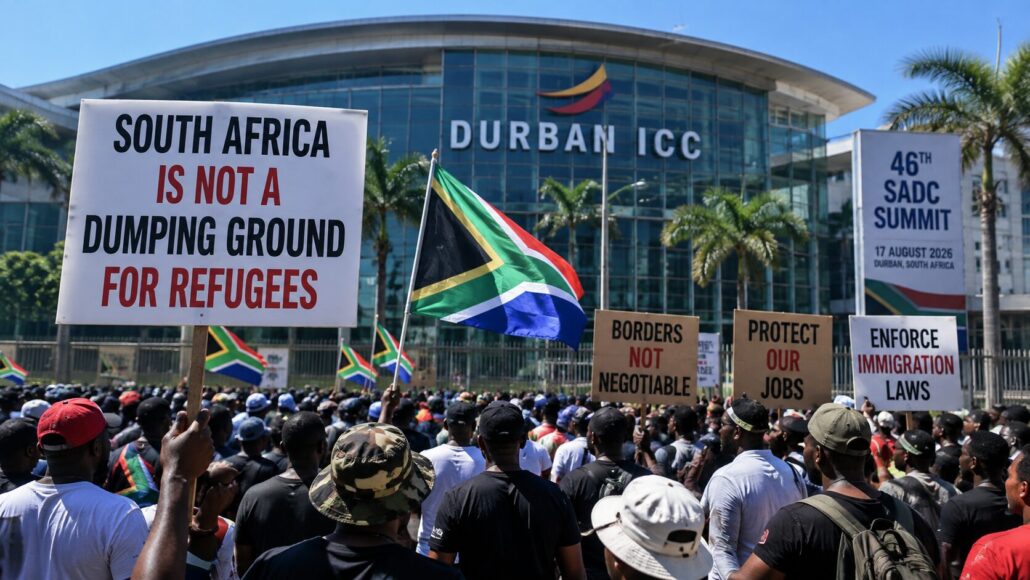
March and March Protest: Durban ICC Action Set for 17 August
South Africa is facing renewed tension over illegal immigration, with the March and March Movement calling on South African citizens to join a planned protest outside the Durban International Convention Centre (ICC) as Southern African leaders gather for the 46th SADC Summit.
The planned demonstration is expected to take place on Monday, 17 August 2026, outside the Durban ICC in KwaZulu-Natal, where the SADC Heads of State and Government Summit is scheduled to take place.
March and March says the protest is intended to put pressure on SADC leaders to take greater responsibility for their citizens living in South Africa and to push the South African government to strengthen immigration enforcement.
The movement has also used the slogan that “South Africa is not a dumping ground for refugees” in its messaging around the planned action.
When and Where Is the March and March Protest?
According to the movement’s public calls, the demonstration is planned for:
| Protest detail | Information |
|---|---|
| Date | Monday, 17 August 2026 |
| Location | Durban International Convention Centre (ICC) |
| City | Durban, KwaZulu-Natal |
| Reason | Pressure SADC leaders over migration and undocumented immigration |
| Organiser | March and March Movement |
| Related event | 46th SADC Summit |
The 46th Ordinary Summit of SADC Heads of State and Government is scheduled for 17 August 2026 at the Durban ICC. The venue has confirmed that the summit will bring together heads of state, government officials and regional leaders from across Southern Africa.
At the time of publication, a specific starting time for the March and March picket had not been independently confirmed by an official government or Durban ICC notice. Readers should therefore verify any circulating time before making travel plans.
Why Is March and March Protesting at the Durban ICC?
The choice of location is directly connected to the SADC summit.
March and March wants the regional leaders attending the summit to address migration issues involving their citizens in South Africa. The movement has argued that South Africa carries an unfair burden when undocumented migrants from other SADC countries live and work in the country.
Its position is centred on border control, undocumented immigration, deportation and stronger enforcement of South Africa’s immigration laws.
March and March has previously described its campaign as being directed at undocumented immigration rather than nationality itself and has said its demonstrations are intended to be peaceful.
However, the movement’s activities have become part of a much wider and increasingly tense national debate about migration, unemployment, crime, public services and xenophobia.
What Happened During the June 30 Protests?
The planned Durban ICC protest comes after a major nationwide mobilisation on 30 June 2026.
March and March had set 30 June as an unofficial deadline for undocumented migrants to leave South Africa. Protests were held in several major centres, including Durban, Johannesburg and Pretoria.
In Durban, thousands of people marched through the city before a memorandum was handed over at the Point Police Station. March and March leader Jacinta Ngobese-Zuma subsequently said the movement would continue its campaign.
The June 30 protests were not entirely peaceful nationwide. Reuters reported violence, looting and clashes with police in some areas, while foreign nationals fled some communities amid fears of attacks.
That history makes the security arrangements around the upcoming SADC summit particularly significant.
March and March Promises Continued Protests
Following the June 30 demonstrations, Ngobese-Zuma said the movement would continue taking action.
The Citizen reported that March and March planned weekly protests for six months, while eNCA reported that the movement intended to continue demonstrating until its concerns over illegal immigration were addressed.
The movement has subsequently continued holding protests in KwaZulu-Natal.
In July, March and March supporters demonstrated in Mtwalume, with the march moving from Gobhela Primary School towards the Umzumbe Municipality offices. The South Coast Herald reported that the demonstration was peaceful at the time of its report.
Why the SADC Summit Matters
The Durban protest is significant because the SADC summit brings together the leaders of the very countries from which many migrants in South Africa originate.
SADC has 16 member states and focuses on regional cooperation, economic integration, peace, security and development.
The Durban ICC says the 2026 summit will address issues including regional integration, economic cooperation, peace, security and sustainable development. President Cyril Ramaphosa is also expected to assume the SADC chairpersonship for the 2026/27 term.
For March and March, the summit therefore provides an opportunity to take its migration demands directly to regional leaders.
Durban ICC Security Tightened Ahead of SADC Summit
Security is already a major consideration ahead of the summit.
The National Joint Operational and Intelligence Structure (NATJOINTS) held a media briefing on 11 August 2026 at the Durban ICC to outline security and operational preparations for the summit.
SABC has reported that security authorities have warned that disruption at the SADC Summit will not be tolerated, highlighting the heightened security environment around the gathering.
The planned March and March protest therefore comes as authorities prepare for a major international diplomatic event.
Anti-Foreigner Unrest vs the Immigration Debate
The latest protests should be understood within a broader distinction between debate over immigration policy and violence or discrimination against foreign nationals.
South Africa has legitimate policy questions surrounding undocumented immigration, border management, asylum processing and enforcement. At the same time, foreign nationals who are legally present in South Africa have rights, and violence, intimidation or collective punishment based on nationality is not a lawful substitute for immigration enforcement.
The June protests demonstrated how quickly tensions can escalate.
Reuters reported that the June 30 mobilisation contributed to violence and displacement in some communities, while the government and other authorities have repeatedly called for concerns about immigration to be addressed through lawful processes rather than violence.
Why Is Anti-Foreigner Tension Rising in South Africa?
The debate is being driven by several overlapping issues:
Unemployment
South Africa’s extremely high unemployment rate has made access to jobs one of the most politically sensitive issues surrounding migration.
March and March supporters argue that undocumented migrants are competing with South Africans for employment and economic opportunities.
Border Control
The movement has repeatedly demanded stronger border management and more resources for authorities responsible for monitoring South Africa’s borders.
Following the June 30 protests, Ngobese-Zuma called for an increase in the Border Management Authority’s budget.
Public Services
Migration has also become part of arguments around pressure on healthcare, housing, education and other public services.
However, claims that migrants are responsible for South Africa’s broader economic problems should not be presented as established fact. These issues involve multiple structural causes, including unemployment, inequality, governance and service-delivery failures.
Crime
Crime is another major part of the debate.
March and March has linked undocumented immigration with crime and insecurity, while critics argue that blaming migrants collectively can fuel xenophobia and distract from the underlying causes of South Africa’s crime problem.
What Happens on 17 August?
The key focus will be whether the planned March and March picket proceeds as announced and how authorities manage the demonstration while protecting delegates attending the SADC Summit.
The Durban ICC will be hosting regional heads of state and government, making the event one of the most heavily secured diplomatic gatherings in South Africa during August.
Any disruption, confrontation or violence could therefore attract significant national and international attention.
For residents and visitors in central Durban, the protest and summit could also mean increased police visibility, security checkpoints, traffic restrictions and changes around the ICC precinct.
Previous Durban Protests Over Immigration
Durban has become one of the major centres of South Africa’s current immigration protests.
On 30 June, thousands of March and March supporters marched through the Durban CBD before proceeding towards Point Police Station.
The movement also held its first-anniversary protest in Durban on 25 March 2026, with supporters marching from King Dinuzulu Park to the Durban CBD and handing over a memorandum to authorities.
The latest planned Durban ICC action therefore forms part of a months-long campaign rather than being an isolated demonstration.
What March and March Wants
The movement’s campaign has included demands for:
- Stronger border control
- Increased resources for border-management authorities
- Action against undocumented immigration
- Deportation of undocumented foreign nationals
- Greater enforcement of South Africa’s immigration laws
- Greater accountability from neighbouring countries over their citizens in South Africa
Ngobese-Zuma has previously called for the government to declare a state of emergency over illegal immigration and has demanded action against undocumented foreign nationals.
Is the Durban Protest Against All Foreign Nationals?
March and March has publicly framed its campaign around undocumented immigration, rather than saying that every foreign national should be targeted.
However, the broader anti-migrant climate has raised concerns among civil society organisations and migrant communities about the potential for legal migrants, refugees and asylum seekers to also become targets.
That distinction is important when reporting on the protests: undocumented immigration status is a legal issue, while nationality itself is not evidence of unlawful activity.
Frequently Asked Questions
When is the March and March protest in Durban?
The planned March and March demonstration is expected to take place on Monday, 17 August 2026.
Where will the March and March protest take place?
The protest is planned outside the Durban International Convention Centre (Durban ICC) in central Durban, KwaZulu-Natal.
Why is March and March protesting outside the Durban ICC?
The movement says it wants to put pressure on SADC leaders attending the summit to address migration and take greater responsibility for their citizens living in South Africa.
What is happening at the Durban ICC on 17 August 2026?
The Durban ICC is hosting the 46th Ordinary Summit of SADC Heads of State and Government on 17 August 2026.
Is the protest about illegal immigration?
March and March says its campaign is focused on undocumented immigration and stronger enforcement of immigration laws.
Has March and March protested in Durban before?
Yes. The movement held major demonstrations in Durban on 30 June 2026 and earlier on 25 March 2026.
Will there be increased security in Durban?
Yes. Authorities are preparing a major security operation around the SADC Summit, with NATJOINTS briefing the media on security preparations on 11 August.
The Bigger Picture
The planned 17 August March and March protest outside the Durban ICC comes at a particularly sensitive moment for South Africa.
The country is dealing with intense public frustration over unemployment, crime, undocumented immigration and pressure on public services, while the government is simultaneously preparing to host senior leaders from across Southern Africa.
The challenge for authorities will be balancing the constitutional right to peaceful protest with the need to protect summit delegates, residents and businesses — while ensuring that legitimate concerns about immigration do not become a justification for violence or attacks against people because of their nationality.
With the SADC Summit taking place at the Durban ICC on 17 August, the protest is likely to draw significant attention both in South Africa and across the region.
